
Although we think the Cosmoscope is a credible public service simply by aggregating access to sites across the globe, it’s reasonable for the community to expect us to work toward our own remotely controlled observatory.
Telescopes are best located at altitude and far away from city lights. Kansas obviously offers no mountaintops, but there are locations where skies are conspicuously dark. Even within a short drive of the Cosmosphere we believe we can find a suitable dark sky location for a modest observatory capable of the sort of medium-length exposures required for “live” viewing.
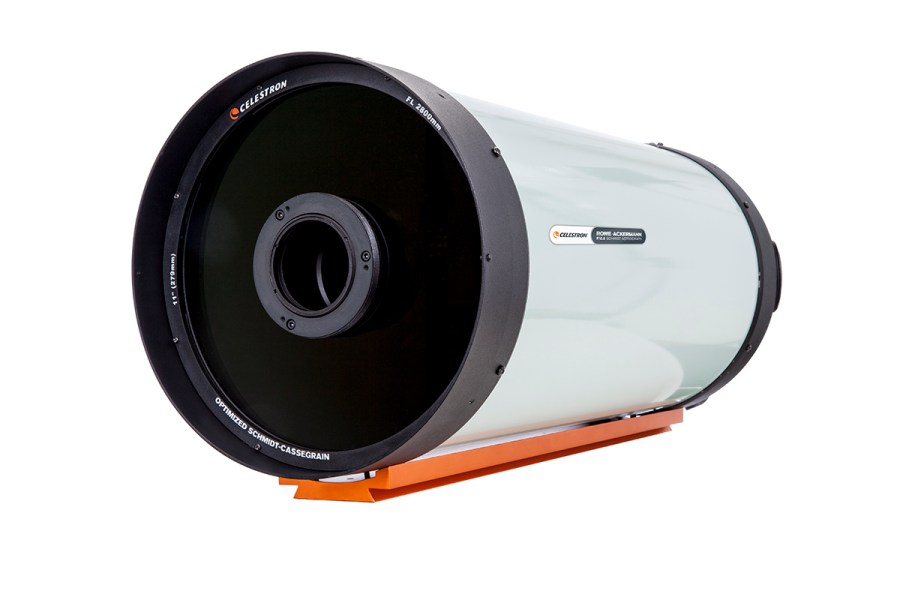
Rather than invest in university-class, relatively exotic hardware, we propose to make best use of high-end consumer equipment from mass manufacturers. As an example, 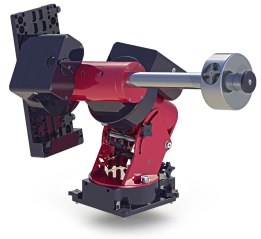 Celestron’s 11-inch telescopes are put to good use by remote telescope operator Slooh. Colorado-based manufacturer Bisque makes equatorial mounts for less than $10,000 that achieve pointing accuracies near those of truly professional equipment. Digital camera manufacturer Diffraction Limited offers units with various combinations of resolution and sensitivity.
An advantage of the “pro-sumer” approach is obviously the economies of scale of the development 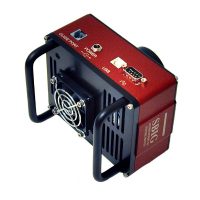 of this hardware, but also the expertise and ingenuity of a large user base. Much of this equipment comes with computer control software already anticipating remote use via internet protocol.
Another possibility to be considered is the local School District’s observatory dome already within view, or nearly so, of the Cosmosphere itself. We suspect there are maintenance issues that would be more expensive to solve than starting from scratch, but – depending upon the bragging rights any given stakeholder might seek – there maybe a remarkably quick path toward a Cosmoscope-operated dome! A caution that school observatories located in other than the ground floors of their buildings (certainly not anchored to bedrock) are notoriously bad about building vibration marring images. (The Mabee Observatory at Bethel College exhibits this weakness, we’re told.) If the HVAC system in the building could be temporarily disabled during Cosmoscope hours, this could be a solution, as could moving the dome and any existing equipment to a dark sky location.
 Using high end, but still consumer-class PCs, we hope to both develop our own expertise and that of interested members of the community. In the early years it might be useful to make it clear that our imaging mission is for artistic purposes, for public outreach rather than spectrometry or other science, freeing us to use commercially-available software like Photoshop without the rigors of documenting the precise data manipulation being employed. Alternately, or down the road, we could become the go-to experts on the traits and idiosyncracies of past hardware, making a case that we can digitally “undo” unavoidable artifacts of the original image capture, rendering classic images in higher fidelity than ever before.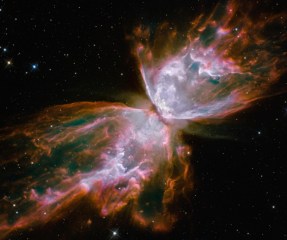
 could be secured (at midwestern rental pricing!) To serve also as the offices for the larger Cosmoscope project. The exact nature of this space may be chosen based
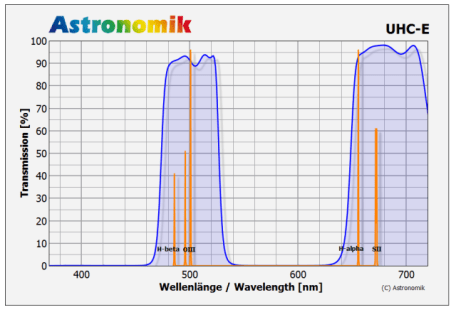 evalent of these atoms emitting in the visual spectrum are hydrogen and oxygen.
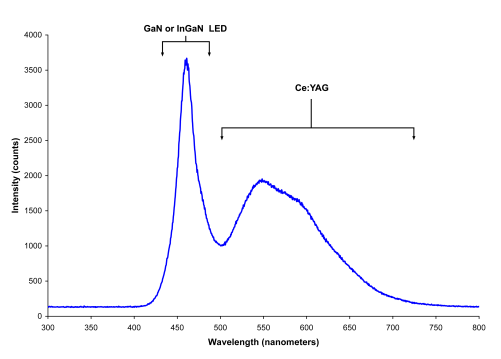 It turns out that by lucky coincidence, the color of doubly-ionized oxygen falls between the blue LED emission and the phosphor re-emission! Note the two charts here produced for different purposes. The yellow lines in Astronomik’s chart are the “colors” of interest. The bottom chart is the color curve for white LEDs. Note that the LED curve dips right at 500nm – the frequency…, the color… of interest! This is a teal, right between green and blue. The other color of greatest use – a red – is the stronger of two hydrogen colors, at 656 nm where the phosphor color curve quickly decreases in intensity.
 Cosmoscope