
With a little original research on our part we’ve uncovered some good news for the immediate future of visual astronomy. Elsewhere on the Cosmoscope site you’ll see reference to narrowband astroimaging. This is the technique of selecting for specific “colors,” known to be emitted by deep-sky objects, while filtering out man-made light sources.
Traditional street light glow in the sky has been particularly easy to filter out because these light sources were frequently sodium-vapor or mercury-vapor lamps emit at very specific color frequencies quite different from the dominant colors in emission nebula. These are clouds of gas being energized by stellar radiation, and then re-emitting that radiation as specific colors associated with the atoms involved. The most pr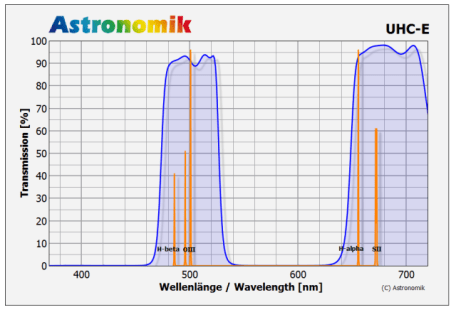 evalent of these atoms emitting in the visual spectrum are hydrogen and oxygen.
So, here’s the good news: We were aware that the white LED lights replacing streetlights nowadays are actually a combination of blue LEDs and phosphors absorbing some of this blue and re-emitting it (very much like nebula) at longer wavelengths, balancing out the blue to create white. (If this is a new concept to you, it’s worth a read. Ingenious.) Anyway, we had heard that these phosphors were rather “sloppy,” emitting across many, many colors, rather than just a few that are easy to filter out.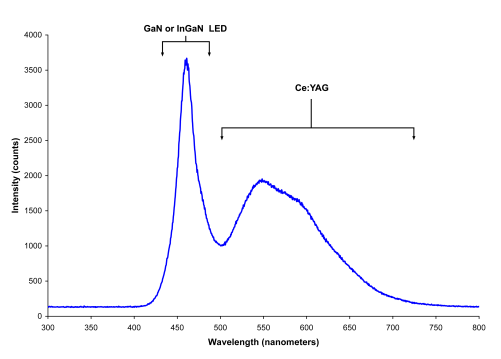 It turns out that by lucky coincidence, the color of doubly-ionized oxygen falls between the blue LED emission and the phosphor re-emission! Note the two charts here produced for different purposes. The yellow lines in Astronomik’s chart are the “colors” of interest. The bottom chart is the color curve for white LEDs. Note that the LED curve dips right at 500nm – the frequency…, the color… of interest! This is a teal, right between green and blue. The other color of greatest use – a red – is the stronger of two hydrogen colors, at 656 nm where the phosphor color curve quickly decreases in intensity.
So, it’s still possible to protect a camera element from man-made light (somewhat) by taking pictures through filters specially “colored” to filter light we don’t want. Although the sheer number and candlepower of LEDs may ruin the sky for visual observers, telescopes can still narrow their attention to these key colors.
This isn’t a perfect situation, and phosphor choices may change in the future, but for now we still can turn a semi-urban telescope location into a site that is much darker for the purposes of photographing certain classes of astronomical objects. This should allow images captured at a Cosmoscope-owned site to produce world-class results with “pro-sumer” scale instruments. We look forward to finding out!
 Cosmoscope